

An ottoman bed has a lift up base that hides a large storage space under the mattress. Two gas pistons, the same kind of strut that holds up a car boot, take most of the weight, so the base rises with a gentle pull and stays open while you load it. If your bedroom is short on storage, an ottoman bed can swallow a small wardrobe worth of bedding, clothes and luggage without adding furniture to the room.
This guide covers how the gas lift works, end lift or side lift, how much storage you really get, weight limits for the mattress and for what you store inside, and what fits and what does not.
What is an ottoman bed?
An ottoman bed is a storage bed where the whole mattress platform lifts on a hinge to reveal one large open compartment underneath. Unlike a divan with drawers, there are no drawer boxes breaking the space up: you get the full footprint of the bed as a single storage area.
When the base is lowered, the storage disappears and the bed looks like any other upholstered frame. That is the appeal: a normal looking bed that quietly holds spare duvets, seasonal clothes and suitcases that would otherwise need a wardrobe or a chest.
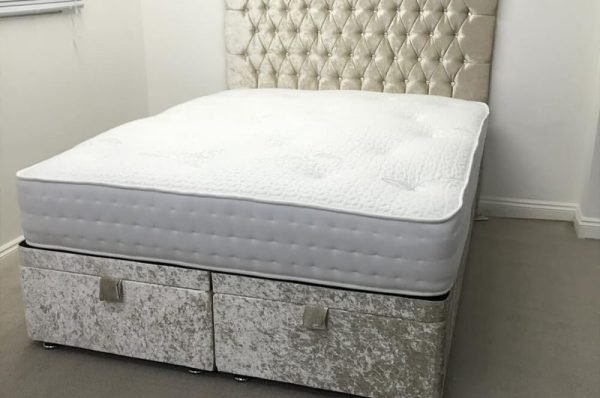
Most ottoman beds are upholstered frames in velvet, chenille, crushed velvet or faux leather, with a deep padded headboard, made to order in standard UK sizes from single to super king.
How does the gas lift mechanism work?
Under the platform sit two gas pistons, one on each side, attached to a hinge at one end of the bed. When you lift the fabric pull strap, the compressed gas inside the pistons expands and takes on most of the weight of the platform and mattress. You only need a light pull to raise it, and the pistons hold the base open while you reach inside. When you push it down, it closes in a controlled way rather than dropping.
The pistons are matched to the weight they need to support, which is why the mattress matters so much. A mattress far heavier or lighter than the bed is designed for can make the base hard to lift, slow to close, or unwilling to stay open. Always check the product page for guidance on mattress weight and depth for that bed.
Gas pistons can gradually lose pressure with age and use. If the bed starts to feel noticeably heavier to lift, or no longer stays open as it once did, replacement struts may be needed. Buying a well made frame with a properly rated mechanism is the best way to avoid that problem.
Lift and close the base using the handle or strap, never by pushing on the edge of the mattress, and check now and then that the bolts holding the pistons and hinges are tight.
End lift or side lift: which should you choose?
Ottoman beds open in one of two ways, and the right choice comes down to the shape of your room and where the bed sits, not personal taste.
| Lift type | Opens from | Best for | Watch out for |
|---|---|---|---|
| End lift | The foot of the bed | Rooms with clear space at the foot, beds between two bedside tables, larger beds | Benches, walls, wardrobes or furniture directly opposite the foot of the bed |
| Side lift | One long side of the bed | Narrow bedrooms, beds tucked into a corner, smaller beds | Doors, radiators and bedside tables on the opening side |
End lift is the most common design. The mattress rises from the foot end and you stand at the end of the bed to load and unload. It suits rooms where the bed sits between two bedside tables or against a wall.
Side lift hinges along one long edge, so the mattress rises sideways and you reach the storage from the side. It is often the practical choice for a single bed in a box room or a bed pushed into a corner. On some designs the mechanism can open from either the left or the right, so check which side suits your room before you order.
Before you decide, measure the clear floor space where the base will rise, and make sure nothing blocks the arc of the rising platform.
How much storage does an ottoman bed actually give you?
The storage compartment runs under most of the mattress, usually around 25 to 30 cm deep. Typical figures are:
| Bed size | Mattress size | Typical storage volume | Roughly holds |
|---|---|---|---|
| Single | 3 ft, 90 x 190 cm | Around 250 litres | 4 to 5 large storage boxes |
| Small double | 4 ft, 120 x 190 cm | Around 300 litres | 5 to 6 large storage boxes |
| Double | 4 ft 6 in, 135 x 190 cm | Around 380 litres | 7 to 8 large storage boxes |
| King | 5 ft, 150 x 200 cm | Around 440 litres | 8 to 9 large storage boxes |
| Super king | 6 ft, 180 x 200 cm | Around 520 litres | 10 to 11 large storage boxes |
These are indicative figures based on typical UK ottoman dimensions. The exact internal measurements vary by model and by how deep the storage compartment is, so check the specification on the individual product page before you buy.
To put the volume in context, a double ottoman base holds about as much as a small wardrobe: a spare winter duvet, two sets of spare sheets, four pillows and two cabin suitcases. Vacuum compression bags shrink bulky bedding to about a third of its volume, which effectively triples the usable capacity for duvets and pillows.
Weight limits: what the struts can lift and what the frame can hold
Two separate limits apply to an ottoman bed, and it helps to keep them apart.
The first is the lifting capacity of the gas struts, which are calibrated for a specific mattress weight. Heavy stored items add to what they must raise. As a broad guide, most ottoman frames handle a mattress of around 40 to 60 kg comfortably. A deep pocket sprung or heavy latex mattress can weigh 50 to 85 kg, so it needs a frame with suitably rated struts, often 900N to 1350N on larger beds. If you pair a heavy mattress with struts rated for a light one, the platform will feel heavy to lift and may not stay open. Check the stated maximum mattress weight on the product page and respect it.
The second limit is what you store inside. A common practical guide is around 30 to 50 kg of stored contents, though this varies by model. Overloading rarely breaks anything outright, but it makes the platform heavy to lift and shortens the life of the struts over time. Put heavier items at the hinge end, nearest the pivot, and use soft sided bags rather than rigid crates.
The frame itself is built to carry two adults and a mattress with a substantial safety margin, so sleeping weight is not usually the limiting factor. The practical constraint is always the lift: if the base becomes hard to raise, you have too much inside, or the mattress is too heavy for the struts.
What fits inside an ottoman bed, and what does not
Because you need to lift the mattress to get inside, an ottoman bed suits large, soft and seasonal items you want nearby but do not need every day:
- Spare duvets, pillows and bed linen, including the winter duvet in summer and the summer quilt in winter
- Out of season clothes in vacuum bags or breathable storage bags
- Suitcases, holdalls and travel bags
- Guest bedding, so spare sheets live inside the bed they serve
- Christmas decorations and boxed items you use a few times a year
- Shoes in boxes, spare blankets and throws
A few things do not belong in there: heavy items such as books or tools, anything damp, because a sealed compartment can trap moisture, valuables you need at short notice, and anything that stops the base from closing flat.
For everyday items you reach for daily, a divan with drawers may be easier, since drawers open without lifting the mattress. Our guide to divan beds versus ottoman beds compares the two storage styles in detail.
Choosing the right size
Ottoman beds come in the full range of standard UK sizes, so start with the sleeping space you need and the size of your bedroom. Our UK bed size guide covers every standard size, from single 3 ft to super king 6 ft, and how to measure your room.
A single ottoman suits a child bedroom, a box room or a guest room, and a side lift is often the practical choice there. A small double works well for a teenager or a compact master bedroom. A double is the most popular size for couples. A king gives two adults noticeably more elbow room, and a super king suits a large master bedroom.
Remember the frame is slightly wider and longer than the mattress, usually by around 5 to 10 cm on each side, so measure the room with the full frame in mind. Leave enough clear floor at the foot or the opening side for the base to lift.
Slatted base or solid base?
Inside the ottoman compartment you will find one of two platform types. A sprung slatted base uses wooden slats across the frame, which give a little and allow air to circulate under the mattress. A solid base uses a firm, continuous board instead of slats, which gives a firmer feel and a flat floor for the storage below.
Neither is right or wrong. Slats suit sleepers who like a touch of give and want airflow under the mattress. A solid base suits anyone who prefers a firmer feel, and it keeps the storage floor tidy, since nothing can slip between slats. Either base works with a memory foam or pocket sprung mattress. Our guide to pocket sprung versus memory foam mattresses explains how to choose between the two.
Ottoman bed or divan with drawers?
The deciding question is what you plan to store. An ottoman gives you the full footprint of the bed as one open space, which is ideal for bulky, irregular items such as suitcases and winter duvets. A divan with drawers gives you two or four separate drawer boxes for everyday items such as spare sheets and clothing, which you can open without lifting the mattress.
An ottoman typically offers up to four times the usable storage of a standard drawer divan, because drawers only use around 40 to 50 percent of the base footprint. But drawers win on everyday access. Many UK homes end up with one of each: an ottoman in the master bedroom for seasonal storage, and a drawer divan in a guest room for daily items.
Ottoman bed buying checklist
Check these before you order:
- Decide which way the bed should open, end lift or side lift, based on where the bed will sit in the room.
- Measure the clear floor needed at the foot or along the opening side for the base to lift.
- Choose the size, from single to super king, based on who sleeps in it and how much room you have.
- Check the maximum mattress weight for the frame, and make sure your mattress sits within it.
- Check the storage depth and internal measurements on the product page, so you know what will actually fit.
- Decide whether you want a mattress included or will use your own.
- Pick a style and fabric, such as plush velvet, chenille or faux leather, that suits the room and is easy to keep clean.
- Check the assembly requirements and the delivery terms before you order.
Frequently asked questions
How much weight can an ottoman bed hold?
The frame supports two adults and a mattress comfortably. The practical limit is the gas lift: most frames handle a mattress of around 40 to 60 kg, plus around 30 to 50 kg of stored items. Check the stated limits on the product page.
Can I use my existing mattress with an ottoman bed?
Yes, in most cases. Pocket sprung, memory foam, latex and hybrid mattresses all work with ottoman frames, as long as the mattress weight does not exceed the rating of the gas struts. A deep, heavy pocket sprung mattress needs a frame with heavy duty struts.
Are ottoman beds hard to lift?
No, not when the mattress is matched to the frame. The gas pistons take most of the weight, so the base rises with a gentle pull and stays open while you load it. If a base feels heavy, the mattress is usually too heavy for the struts.
What size ottoman bed should I buy?
Start with the sleeping space you need and the size of your bedroom. A single suits a child or guest room, a double suits most couples, a king suits couples who want more room, and a super king suits a large master bedroom. Storage runs from around 250 litres for a single to around 520 litres for a super king.
Do ottoman beds last?
Yes, a well made ottoman bed lasts for years. The gas struts are the part most likely to wear, and they can gradually lose pressure with age and use. Lifting with the handle or strap and not overloading the storage helps the mechanism last longer.
Is an ottoman bed better than a divan with drawers?
It depends on what you store. An ottoman gives you far more capacity and handles bulky items such as suitcases and duvets. A divan with drawers gives you easier everyday access without lifting the mattress.
Final thoughts
An ottoman bed is one of the simplest ways to add serious storage to a bedroom without adding furniture. Choose the lift direction to suit your room, match the mattress weight to the gas struts, and check the storage depth on the product page.
Browse the full ottoman beds range at Beds and Beyond, where every bed is handcrafted to order in sizes from single to super king, in a wide choice of premium fabrics. We are based in Batley, West Yorkshire, and our team will help you choose the right size and fabric for your room. We deliver free across the UK, and our Early Black Friday sale on Luxury Beds is live now.

Comments (2)