
Your mattress gets all the attention, but the frame underneath does half the work. A good mattress on a weak frame will sag in the middle, creak every time you move, and wear out years before it should. A well chosen frame, on the other hand, keeps your mattress flat and evenly supported, so it can do its job properly night after night.
So how do you choose a supportive bed frame? Look for strong side rails and solid corner joints, slats spaced no more than 7cm apart, a centre support rail with floor legs on any frame wider than a single, a clearly stated weight capacity, and a base type that suits your mattress. Get those five things right and the style, fabric and headboard become a matter of taste, not a gamble.
This guide explains each of those checks in plain terms, compares the main base types sold in the UK, and finishes with a quick checklist you can use before you order.
What Makes a Bed Frame Supportive?
Support is not one feature. It is the whole structure working together to hold your mattress flat, spread your weight evenly, and stay rigid for years. Five elements matter most.
A rigid perimeter. The side rails and the head and foot ends form the frame that everything else hangs from. Thick, solid rails resist bowing outwards under load. Thin rails flex, and once they flex the whole base starts to move.
A centre support rail. On any frame wider than a single, a centre rail running head to foot stops the middle from dipping. The best designs add one or two legs that reach the floor in the middle of the rail, so the weight is carried down to the floor rather than hanging from the side rails alone.
Close, well fixed slats. Slats carry the mattress. If they are too far apart, the mattress sinks between them and the springs or foam beneath can be damaged over time. Aim for gaps of 7cm or less, and check that each slat is screwed or clipped firmly in place rather than simply resting loose in a groove.
Solid joints. Corners held together with bolts and metal brackets stay tight. Joints that rely on a single wooden dowel or a friction fit loosen with use, and a loose frame is a creaking frame.
A stated weight capacity. A maker that publishes a weight limit has tested the frame. A listing that only says strong or sturdy has told you nothing. Check whether the figure is per sleeper or for the frame as a whole, and do not assume a single sleeper rating can simply be doubled for a double bed.
Slatted, Solid or Divan: Which Base Supports Best?
Most UK bed frames use one of four base types. Each supports the mattress differently, and the right choice depends on your mattress and how you sleep.
| Base type | How it supports | Airflow | Best matched mattress | Watch out for |
|---|---|---|---|---|
| Solid slats | Firm, flat and even, the mattress does the contouring | Good, air moves between slats | Pocket sprung and firmer mattresses | Gaps wider than 7cm let the mattress dip |
| Sprung slats | Curved slats flex gently and absorb movement | Good | Memory foam and hybrids that benefit from a little give | Very soft slats can feel bouncy under heavier sleepers |
| Solid platform | One continuous surface, very stable and quiet | Limited, can trap warmth and moisture | Orthopaedic and firm mattresses | Poor airflow can make the sleeping surface warmer |
| Divan base | Firm upholstered box, often with drawer storage | Limited | Almost any mattress, especially with a sprung edge top | Check the base is solid timber, not thin board |
| Ottoman base | Solid timber frame with a lift up storage compartment | Limited | Pocket sprung and foam, as with a platform | The gas lift mechanism should open smoothly and stay up |
There is no single winner. If you like a firm, unyielding feel and want your mattress to do all the contouring, solid slats or a platform base are the natural picks. If you want a touch of give that softens the overall feel, sprung slats suit you better. Divan and ottoman bases are the practical choice when storage matters, and both give firm, even support when they are built on a solid timber frame. Our ottoman beds pair that storage with a solid timber frame, so you do not trade support for space.
Frame Materials and Construction
The material matters less than the way it is put together, but some general rules help.
Solid timber is the classic choice for a reason. Dense hardwoods hold screws well, resist warping, and stay quiet. Cheaper softwood frames can work, but they need thicker sections and better joints to match the same rigidity, so look closely at the rail thickness and the corner fixings.
Metal frames can be very strong when the joints are welded and the rails are proper steel sections rather than thin tube. A metal frame with a mesh or metal slat base suits heavier mattresses well, but check for a centre support rail on wider sizes, just as you would with wood.
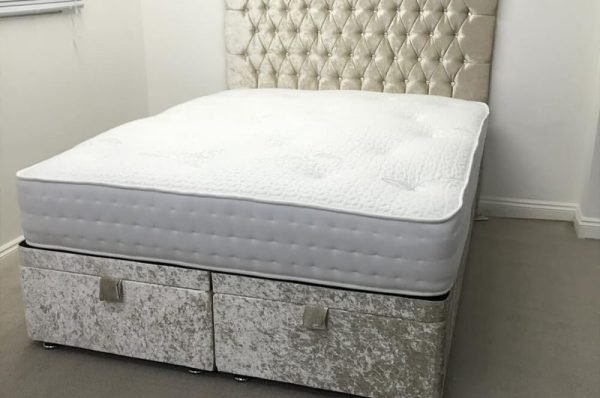
Upholstered frames wrap the structure in fabric, which looks and feels luxurious and gives you a soft surface to lean against. What matters is what sits underneath the fabric: a solid timber frame with bolted corners. The upholstery is the finish, not the structure, so ask what the frame itself is made from. Our luxury beds are built on sturdy solid timber frames with deep, high headboards, and every one is made to order in a choice of premium fabrics.
Whatever the material, run through these construction checks before you buy:
- Side rails at least 25mm thick on a double or larger frame
- Corner joints bolted or bracketed, not held by friction alone
- A centre support rail with floor legs on double, king and super king sizes
- Slats screwed or clipped down, with gaps of 7cm or less
- A weight capacity stated in the product details
Check the Weight Capacity Before You Buy
Weight capacity is the simplest quality signal a listing can give you, and it is the one most often missing. If it is there, read it carefully, because makers do not all express it the same way.
Some state a maximum weight per sleeper. Others state a total load for the frame. A few quote a test figure that includes the mattress and bedding. If the listing is vague, ask the retailer before ordering. A frame that is rated well above your combined weight, including the mattress, will stay rigid and quiet for years. A frame running close to its limit will start to creak and flex much sooner.
Heavier mattresses need more from a frame, too. A deep pocket sprung mattress can weigh considerably more than a slim foam one, so factor the mattress into the total. If you are buying the frame and mattress together, choosing them as a pair makes this easy: the maker will have matched them.
Match the Frame to Your Mattress
The frame and the mattress are a team. The wrong pairing can make a good mattress feel wrong, and can even shorten its life.
Pocket sprung mattresses need closely spaced, firm support. Wide slat gaps let individual springs sink between the slats, which can damage the spring unit and may affect a warranty. Solid slats with gaps under 7cm, a divan base, or a solid platform all suit them well.
Memory foam mattresses need even support and airflow. They contour to your body, so the base should be flat and consistent, with enough ventilation underneath to let moisture escape. Slatted bases suit them well for exactly that reason, and sprung slats add a gentle give that many foam sleepers enjoy.
Hybrid mattresses, which combine springs with foam comfort layers, are the most forgiving. They work well on any properly built base, which is one reason they are so popular in the UK today. If you are still deciding between spring and foam, our guide to pocket sprung vs memory foam mattresses walks through the differences in feel, temperature and suitability for each sleeping position.
One rule covers every combination: check the mattress maker’s guidance on base type and slat spacing before you buy. It takes a minute, and it protects both your comfort and your guarantee.
Size, Space and Getting It Through the Door
Support is pointless if the frame does not fit the room or cannot get into it. Measure before you order, not after delivery.
First, check the frame’s outside dimensions, not just the mattress size. Upholstered and wingback frames can add 8 to 15cm beyond the mattress on each side, and a tall headboard adds depth as well. Our UK bed size guide lists every standard size from single to super king, with the room space each one needs.
Second, allow walking room. Aim for 60 to 90cm of clear floor on each side of the bed where you get in and out, and similar space at the foot. Below 60cm, daily life gets awkward fast.
Third, measure the route in. Check the narrowest doorway, hallway and stairwell turn between your front door and the bedroom. One piece upholstered headboards do not bend around tight landings. A divan base, which usually arrives in two halves, is often the easier choice for awkward access. Our divan beds are built on a sturdy solid timber base with drawer storage, and the two part base helps with delivery into tighter homes.
Signs Your Current Frame Is Not Supporting You
You do not always need a new frame, but these are the signs that the one you have is past its best:
- Creaking or groaning when you move, even after tightening every bolt
- A visible dip in the middle of the mattress when the bed is empty
- Slats that slip out of place, crack, or bow downwards
- The frame rocks or wobbles when you sit on the edge
- Your mattress has developed a permanent hollow where you sleep
A single loose slat is a quick fix. A frame that sags in the centre, or whose joints will no longer tighten, is telling you its structure has given up. Putting a brand new mattress on a failing frame will not fix the problem, and it can wear the new mattress out early.
A Quick Checklist Before You Order
- Slat gaps of 7cm or less, with each slat fixed firmly in place
- Centre support rail with floor legs on double, king and super king frames
- Bolted or bracketed corner joints
- A clearly stated weight capacity that covers both sleepers plus the mattress
- A base type matched to your mattress: close slats for pocket sprung, airflow and even support for memory foam
- Outside dimensions checked against your room, with 60 to 90cm of walking space each side
- Doorways, hallways and stairwell turns measured for delivery
- A frame material and build you would be happy to live with for 8 to 10 years
Frequently Asked Questions
What is the most supportive type of bed frame?
A solid timber frame with fixed solid slats, a centre support rail and bolted corners is widely regarded as the most supportive option, because it gives a flat, unyielding surface that lets the mattress do the contouring. Divan and platform bases offer similar firmness. The best choice still depends on your mattress and how firm you like your bed to feel.
Are slatted beds good for support?
Yes, provided the slats are close together and properly fixed. Gaps of 7cm or less, solid timber slats, and a centre rail on wider frames give even, reliable support with good airflow underneath the mattress. Wide gaps or loose slats are the problem, not slats themselves.
How far apart should bed slats be?
No more than 7cm apart. Wider gaps let the mattress sink between the slats, which causes uneven wear and can damage a pocket sprung mattress over time. If you already own a frame with wide gaps, adding extra slats or a thin plywood sheet cut to size can close them up.
Do I need a centre support rail?
On any frame wider than a single, yes. Double, king and super king frames span a long distance, and without a centre rail the middle will eventually dip under the combined weight of two sleepers and the mattress. Look for a rail with legs that reach the floor.
Can a bad bed frame damage a mattress?
Yes. A sagging or uneven frame lets the mattress dip in the middle, which wears the springs or foam unevenly and can create a permanent hollow. Wide slat gaps can also let pocket springs sink between the slats. A supportive frame protects your mattress and helps it last its full lifespan.
How long should a bed frame last?
A well built frame should last 8 to 10 years at least, and a solid timber frame often lasts much longer. Replace it sooner if it creaks after tightening, sags in the centre, or has cracked slats or joints that will no longer hold firm.
Find a Frame That Supports You Properly
Choosing a supportive bed frame comes down to the structure, not the styling. Check the rails, the joints, the slat spacing, the centre support and the weight capacity, then match the base to your mattress and measure the room before you order. Get those basics right and your mattress will feel better, last longer, and give you the comfortable, undisturbed sleep you bought it for.
Beds and Beyond is a family run business based in Batley, West Yorkshire, handcrafting beds and mattresses to order. Browse the luxury beds, divan beds and ottoman beds ranges to find a frame built on solid timber with the support your mattress deserves, all with free UK delivery. And if you are shopping during our Early Black Friday sale, enjoy 25% off Luxury Beds with code BLACKFRIDAY25 at checkout until 30 November.
General comfort guidance only. If you have persistent back pain or a medical condition affecting your sleep, speak to a clinician before choosing a new bed or mattress.