Furnishing a small UK bedroom — a box room, a tight second bedroom in a new build, or a period terrace with awkward proportions — comes down to one decision more than any other: the bed. Get it right and the room feels calm and organised. Get it wrong and you’re shuffling sideways around an oversized frame for years.
The short answer to “what’s the best bed for a small bedroom?” is this: choose the smallest bed size you can sleep comfortably on, and pick a storage bed so the footprint earns its keep. This guide walks through the best bed types, the sizes that actually work in small UK rooms, how to measure properly, and practical space-saving tips that don’t require knocking down walls.
What Actually Makes a Bed Good for a Small Bedroom?
It’s not just about the bed being small. Three things matter:
Footprint discipline. A bed’s footprint is the mattress size plus whatever the frame adds. A divan base sits almost exactly flush with the mattress — nothing wasted. Upholstered frames can add 8–15 cm beyond the mattress on each side, and a deep headboard eats into the room’s length. In a tight room, those centimetres count.
Storage that replaces furniture. A storage bed can absorb an entire chest of drawers’ worth of clutter. If the bed holds your spare bedding, seasonal clothes or suitcases, you may not need that extra piece of furniture at all — and in a small room, one fewer piece of furniture is transformative.
How the storage opens. This is the detail people miss. Drawers need floor clearance beside the bed to slide out. An ottoman base lifts vertically and needs headroom instead. The right mechanism depends on your room’s layout — which we cover below.
The Best Bed Types for Small Bedrooms
1. Ottoman storage beds — the small-room champion
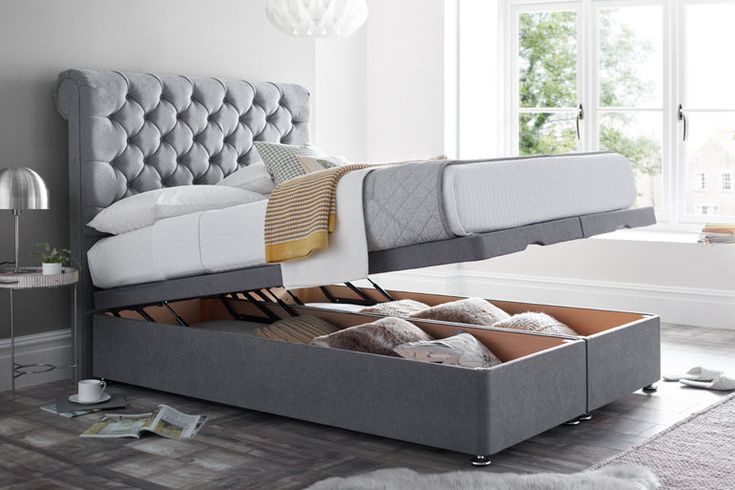
An ottoman bed looks like an ordinary upholstered bed, but the whole mattress platform lifts on gas-lift pistons to reveal one large storage cavity underneath — headboard to foot, side to side. For genuinely tight rooms, ottomans are hard to beat: they need no floor clearance at the sides to open, so the bed can sit flush against a wall and still give full storage access.
That one continuous compartment swallows bulky items drawers can’t take — winter duvets, spare pillows, suitcases, seasonal clothing. The trade-off is access: lifting the whole platform takes more effort than pulling a drawer, so ottomans suit items you reach for occasionally rather than daily. You’ll also need enough ceiling height for the platform to rise — worth checking in loft rooms with sloping eaves.
Our ottoman bed range is made to order from single to super king, with a smooth gas-lift mechanism and a solid timber frame, in fabrics including velvet, chenille and faux leather.
2. Divan beds with drawers — quick everyday storage
A divan is a fully upholstered base that the mattress sits directly on top of, with drawers built into the sides. The base matches the mattress size almost exactly, so the footprint is minimal. For items you grab daily — clothes, towels, the bedding you’re rotating — nothing beats the convenience of a drawer that glides open in seconds.
The catch: drawers need around 60 cm of clear space on the drawer side to open fully. If the bed is wedged tight between two walls or pushed hard against one wall, some drawers may be awkward or impossible to use. Divans are also generally the more affordable storage bed and the base typically arrives in two halves — a genuine advantage when the bed has to go up a narrow staircase.
Our divan beds are built on a sturdy solid timber base with built-in drawer storage, made to order from single to super king in a wide range of fabrics.
If you’re torn between the two, our divan vs ottoman comparison breaks down storage capacity, access, room layout and price in detail.
3. Small doubles in storage formats — the sweet spot
The small double (4ft / 120 cm wide) is the unsung hero of the small bedroom: 30 cm wider than a single, so a solo sleeper can spread out, but far less room-hungry than a full double. In storage formats — ottoman or drawer divan — a small double gives you generous hidden storage without dominating the room. It’s the size we’d recommend most often for spare rooms and teenagers’ rooms that need to work hard.
4. Low-profile and compact frames
If you don’t need storage in the bed itself, a slim-framed divan or a low-profile upholstered bed keeps the visual bulk down. Shorter headboards make ceilings feel higher, and lighter fabrics keep the room feeling airy. Just remember that without storage in the bed, you’ll need somewhere else for the clutter — in a small room, that’s a real cost.
Ottoman vs Divan vs Standard Frame: Side by Side
| Feature | Ottoman storage bed | Divan with drawers | Standard (non-storage) frame |
|---|---|---|---|
| Storage style | One large under-bed compartment | 2–4 built-in drawers | None — empty space under frame |
| Storage capacity | Largest — full footprint | Moderate — limited to drawer size | None |
| Clearance to open | None at floor level; needs headroom above | ~60 cm beside the bed for drawers | N/A |
| Best against a wall | Excellent | Some drawers may be blocked | Fine, but no storage gain |
| Access speed | Slower — lift the platform | Fast — pull a drawer | N/A |
| Best for | Seasonal items, bedding, suitcases | Everyday clothes and bedding | Rooms with separate storage |
What Size Bed Fits a Small UK Bedroom?
Standard UK mattress sizes are fixed, so start here and work backwards from your room’s measurements:
| Bed size | Mattress dimensions | Practical minimum room width | Works well for |
|---|---|---|---|
| Single (3ft) | 90 × 190 cm | ~210 cm, one side clear | Box rooms, kids, guest rooms |
| Small double (4ft) | 120 × 190 cm | ~240 cm, one side clear | Solo sleepers, spare rooms |
| Double (4ft6) | 135 × 190 cm | ~290 cm, both sides clear | Couples in standard bedrooms |
The clearance assumption is roughly 60–75 cm of walking space on each accessible side — the room a person needs to get in and out of bed and move around it comfortably.
Here’s the honest advice most retailers won’t give you: a small double with one clear side is usually more comfortable to live with than a full double wedged wall to wall. The extra 15 cm of sleeping width is not worth it if you can’t walk around the bed or open the wardrobe. For a full breakdown of every UK bed size and who each suits, see our UK bed size guide.
Measure Before You Buy: The 60 cm Rule
Before ordering any bed for a small room, run through this checklist:
1. Measure the room — length and width, wall to wall, in centimetres.
2. Use the frame’s dimensions, not just the mattress. Upholstered and wingback frames can add 8–15 cm beyond the mattress on each side; check the overall dimensions on the product page.
3. Allow 60–75 cm of clear floor on each side you’ll get in and out of, and at the foot. In a tight room, 60 cm is workable. Below that, daily life gets annoying fast.
4. Tape it out. Mark the bed’s footprint on the floor with masking tape and live with it for a day. It’s the cheapest way to know whether a size works.
5. Check the route in. Measure the narrowest doorway, hallway and any stairwell turns between your front door and the bedroom. Divan bases typically arrive in two halves, which negotiate tight stairs far more easily than a one-piece upholstered frame.
6. Account for the door swing — a door that opens onto the bed’s corner will drive you mad within a week.
7 Space-Saving Tips for Small Bedrooms
1. Push the bed against the wall — and choose the right opening. If one side is against the wall, a side-opening ottoman still gives full storage access from the open side, or pick an end-lift ottoman that opens from the foot. No drawer goes unused.
2. Go vertical. A tall, narrow wardrobe holds as much as a wide chest of drawers in half the floor space. Floating shelves keep surfaces clear without touching the floor.
3. Mount the lighting. Wall-mounted reading lights free up bedside table space — or skip the table entirely with a clip-on shelf.
4. Use mirrors deliberately. A mirror opposite or beside the window bounces light around and makes the room feel twice its size. Keep the frame slim.
5. Keep the bed visually light. Lighter upholstery fabrics and lower headboards make a small room feel airier. Save the dramatic tall wingback for a bigger room.
6. Swap bulky bedside tables. A slim floating shelf or a narrow stool holds a book, a glass of water and a lamp — that’s all a bedside table needs to do.
7. Declutter the surfaces. A small room shows every stray item. With storage in the bed handling the bulky stuff, keep surfaces to the essentials and the room will feel calm.
Frequently Asked Questions
What type of bed is best for a small bedroom?
An ottoman storage bed or a divan bed with drawers. Both keep the footprint tight while adding storage that can replace a chest of drawers. Ottomans suit the tightest rooms because they need no floor clearance to open; divans suit anyone who wants fast daily access to stored items.
Are storage beds worth it for a small room?
Yes — often they’re the single most effective upgrade. The space under a bed is roughly equivalent to a wardrobe’s worth of storage, and using it means one fewer piece of furniture competing for floor space.
Should I get an ottoman or a divan with drawers for a small room?
If the bed will sit against a wall or the room is genuinely narrow, an ottoman — it opens vertically and needs no side clearance. If you’ll open the storage daily and have ~60 cm beside the bed, a divan’s drawers are quicker and easier. Our divan vs ottoman guide compares them in full.
Can a double bed fit in a box room?
Usually not comfortably. A double needs around 290 cm of width with both sides clear for two sleepers. In a box room, a single or small double with storage is the realistic choice — you’ll sleep better with walking space than with extra mattress width you can’t move around.
How much walking space should I leave around the bed?
Aim for 60–75 cm on each accessible side and at the foot. Sixty centimetres is the workable minimum for getting in and out and making the bed; below that, the room starts to feel cramped no matter how nice the bed is.
Find Your Small-Room Bed
The best bed for a small bedroom is the one that fits your room, stores your clutter and suits how you actually live. Whether that’s the full-base hidden storage of an ottoman or the everyday convenience of a drawer divan, every bed at Beds and Beyond is handmade to order at our Dewsbury, West Yorkshire workshop — in sizes from single to super king and a wide choice of fabrics — with free UK delivery on orders over £100.
Browse the ottoman bed collection and divan bed collection to find yours.